

Septic sets the elevation
The drainfield has to clear the flood elevation, and the house has to work with the drainfield. Site preparation starts from that relationship, because it sets your pad height before anything else.
Now scheduling projects
+1 (239) 359-8463Southwest Florida · Licensed and insured
Lehigh Acres · Lee County, FL
▸ Fill and pad, done to elevation
Site preparation for Lehigh Acres lots: clearing, fill placed in compacted lifts, building pad to elevation, drainage and access for a build that passes.
How a platted lot becomes a build site
Most Lehigh lots were platted decades before anyone built on them. What looks like flat, easy ground is where site preparation decides your elevation — and where an inspection gets failed or passed.
01
We walk the parcel with your plans: access, setbacks, what stays, what goes, and where the machines can actually work without tearing up the rest of the lot.
02
We confirm what the parcel needs before anything moves — vegetation removal, right-of-way, and any protected-species survey that applies. Nothing starts on a lot that is not clear to start.
03
Vegetation, stumps and roots removed inside the approved limits. Grubbing matters: organic material left under a pad is what settles later.
04
Topsoil and organics stripped off the building area, then the subgrade is proof-rolled to find the soft spots before they become a problem under the slab.
05
Where the proof-roll finds muck, roots or unsuitable material, it comes out and gets replaced. This is the step that is invisible when it is done right and expensive when it is skipped.
06
Fill placed in lifts and compacted, not dumped and pushed. Each lift is worked to the moisture it needs so the pad holds the elevation it is built to.
07
The pad shaped to the elevation on your plan and checked, so the builder inherits a surface that matches the drawings instead of a surprise.
08
The ground shaped so water leaves the pad and the structure — flat land does not drain itself, it drains the way it is built to.
09
The route in built to carry the trucks that come next, so the first concrete delivery is not the test of whether your access works.
10
Trenching and access coordinated with the trades that follow, so the sequence after us does not start by undoing what we just finished.
11
Silt fence and site controls in place, the lot walked with you, and the ground handed off to your builder ready for the slab.
Handed off ready for the slab.
The ground here
Lehigh has no municipal sewer, so nearly every home runs on a septic system — and a septic drainfield has to sit above the flood elevation. That single requirement is why fill and a compacted pad are part of site preparation here by permit, not an upgrade.
The drainfield has to clear the flood elevation, and the house has to work with the drainfield. Site preparation starts from that relationship, because it sets your pad height before anything else.
The ground is level and the water table sits close. Water goes where the grading sends it, which means the swales and the pad get planned together.
Quarter-acre lots on a grid laid out long before the neighbours arrived. Many have sat open long enough to grow a canopy that has to come off first.
Fill dumped and pushed looks the same as fill placed in lifts — until it settles. Compaction is the part of site preparation an inspector actually measures.
Before anything moves
Site preparation order matters here more than most places, because the septic, the elevation and the pad are one problem, not three. These are the items we confirm at the site walk.
The septic system is permitted through the health department on its own track. Its drainfield elevation is the number that sets how much fill your pad needs — which is why it is settled first, not last.
Lot elevation has to satisfy the flood requirement for the parcel. Getting the pad to that number is preparation work, and it belongs in the scope from day one.
Fill placed in lifts and compacted, not tipped and levelled. It is the difference between a slab that holds and a settlement crack in year three.
We submit locates and verify utilities before any equipment enters the site — on a grid this old, what is marked and what is there are worth checking.
A lot that has sat unbuilt for years grows more than brush. Trees, stumps and roots come out and get grubbed, because organic material under a pad is what settles.
The route in has to carry concrete trucks. It gets built for that load during preparation, not repaired after the first delivery tears it up.
Owner-operated
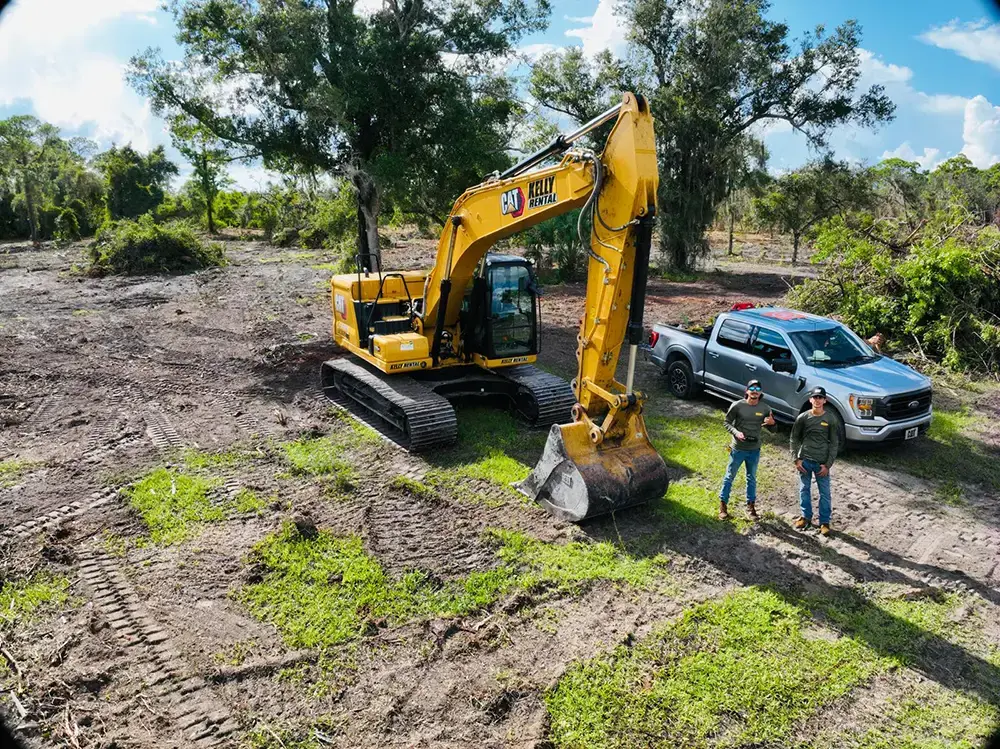
One crew from first walk to final grade. No layers between you and the person who decides how the ground gets handled — which is what keeps a build-ready date from slipping.
Licensed and insured · Owner-operated crew
Coverage
We handle site preparation across Lehigh Acres from our base in Naples — Lee Boulevard, the Gunnery Road corridor, Sunshine Boulevard and the parcels out toward State Road 82.
Before you call
Because flat is not the same as high enough. Lehigh has no municipal sewer, so your septic drainfield has to sit above the flood elevation, and the house has to work with the drainfield. That usually means bringing the pad up — which is site preparation, not an extra.
It comes from your existing grade, the required elevation and where the drainfield sits. We walk the lot and read the plan before we put a number on it. A quote given without either is a guess you pay for later.
It settles, and it settles after the slab is on it. Fill goes in in lifts, each one compacted at the moisture it needs. That is slower than dumping and pushing, and it is the reason the pad holds.
It is normal here and it is step three of site preparation. Trees, stumps and roots come out and get grubbed — leaving organic material under a building pad is one of the surest ways to get settlement later.
Yes, and it matters more here than most places. The drainfield elevation and the pad elevation are one decision, so the site preparation sequence is built around it — neither gets set before the other is known.
Hector TractorNaples, FL · +1 (239) 359-8463
Tell us the address and what needs to happen. You get a clear scope, a real schedule and one crew that owns the work.